
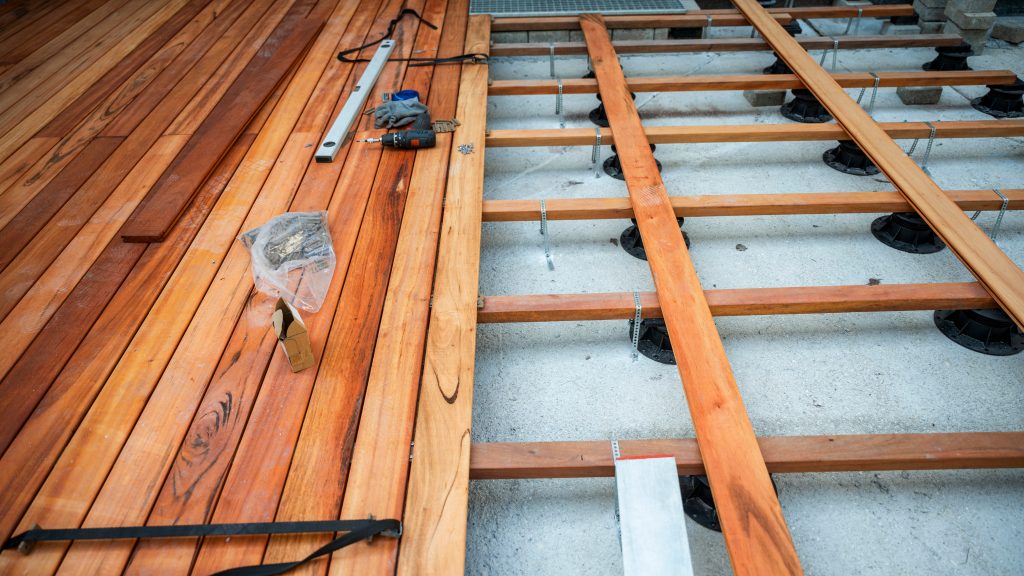
Floor movement is one of those problems that tricks homeowners into spending money in the wrong place. You feel the bounce. You notice the creak. You see a gap forming near the baseboard. So you call a flooring company. They pull up the boards, inspect the subfloor, and tell you everything looks fine. That is because the problem was never in the floor to begin with. Envirotech works with Calgary homeowners who discover, often too late, that structural floor problems originate deep inside the wood framing system beneath their feet. Understanding why floors move — and where that movement actually starts — saves time, money, and a lot of frustration.
What the Floor Is Actually Sitting On
Most people think of a floor as a single layer. It is not. A typical floor assembly includes the finished surface, the subfloor, and then the structural framing beneath it all. That framing is a system of joists — horizontal beams that span the width of the space and carry the load of everything above them.
When joists are properly sized, correctly spaced, and well supported, the floor feels solid and stable. When something goes wrong in that framing layer, everything above it suffers. The finished floor has no choice but to move with whatever happens beneath it.
This is why wood framing is not just a construction detail. It is the foundation of how your floor behaves every single day.
Signs the Problem Is in the Frame, Not the Finish
There is a difference between a surface defect and a structural floor problem. Surface defects look like scratches, stains, warped boards, or gaps caused by humidity. Structural problems feel different. They have movement, flex, and sound.
Watch for these signs:
The floor bounces or flexes when you walk across it. This is almost always a framing issue. A properly framed floor should feel firm underfoot. Flex means the joists are undersized, over-spanned, or compromised.
You hear a deep creak rather than a surface squeak. Surface squeaks often come from subfloor panels rubbing together or boards moving against fasteners. A deeper sound — one that seems to come from below the subfloor — points to movement in the joists themselves.
Doors and windows in the room start sticking or misaligning. When framing shifts, it affects the entire wall system connected to it. A floor that has dropped or twisted slightly puts pressure on surrounding structures.
Cracks appear in walls near floor level. Drywall is rigid. When framing moves, drywall cracks at stress points. A crack running along the base of a wall, especially a diagonal one near a corner, often signals movement in the structural system below.
Common Causes of Structural Floor Problems
Structural floor problems do not appear randomly. They follow predictable patterns tied to age, moisture, load, and original construction quality.
Joist damage from moisture ranks among the most common causes in Calgary homes. Water intrusion from basement leaks, plumbing failures, or condensation causes wood to rot. Rotted joists lose their structural integrity and begin to deflect under normal loads.
Improper spans happen when joists do not match the distance they need to cover. Building codes specify maximum spans for each joist size. When builders cut corners or specifications change mid-project, joists end up carrying more load than they were designed for.
Missing or failed blocking is another frequent cause. Blocking refers to short pieces of lumber that contractors install perpendicular between joists to prevent them from twisting sideways. Without blocking, joists rotate under load and the floor above them becomes unstable.
Notching and boring violations occur when tradespeople cut into joists to route pipes or wires without following code guidelines. A joist with a large notch in the wrong location becomes significantly weaker at that point.
Settlement and shifting in the foundation or support posts can cause one end of a joist to drop. Even a small amount of settlement creates a noticeable slope or soft spot in the finished floor.
Why Surface Repairs Never Solve Structural Problems
This is the part that homeowners learn the hard way. Replacing hardwood over a bouncy floor does not fix the bounce. Installing new tile over a flexing subfloor causes the grout to crack within months. Laying new vinyl over a sagging section just follows the same sag.
Surface materials carry no structural value. They cannot stiffen or support the framing beneath them. Pouring a self-leveling compound can mask a slope temporarily, but it does nothing about the joist that still deflects under load.
The only real solution to a structural floor problem is to address the framing itself. That means assessing the joists, identifying what causes the movement, and either reinforcing, sistering, or replacing the damaged members.
Sistering is a common repair technique. A contractor attaches a new joist directly alongside a damaged one, running the full span and transferring load to the new member. Done correctly, this restores full structural capacity without requiring demolition of the entire floor system.
How Framing Repairs Fit Into a Broader Renovation
Most homeowners do not discover structural floor problems until they are already mid-renovation. They start a bathroom renovation and pull up the tile only to find soft, deteriorated subfloor sitting on compromised joists. They begin a basement finishing project and notice that the floor above bounces when they walk across it.
This timing, while inconvenient, is actually fortunate. When walls are open and subfloors are exposed, framing repairs become far more accessible. Work that would require significant demolition in a finished space becomes straightforward when the renovation is already underway.
Envirotech approaches these situations by assessing the full scope of framing issues before any new finishes go in. There is no point installing a new subfloor on joists that are still compromised. The repair sequence matters. Framing comes first. Everything else follows.
What to Expect During a Framing Assessment
A proper framing assessment starts with access. The contractor needs to see the joists, which typically means working from below if a basement or crawlspace is accessible, or from above if the subfloor is already exposed.
The assessment covers several things. The contractor compares joist size and spacing against the span they cover. They inspect the wood for rot, insect damage, and any notching or boring that may have weakened it. They also check bearing points — the locations where joists rest on walls or beams — because failures at bearing points are particularly serious.
The contractor measures deflection. A joist that sags in the middle under its own weight, before any live load is added, is already compromised. The degree of sag helps determine whether reinforcement is sufficient or whether full replacement is necessary.
From that assessment, the contractor develops a scope of repair. The homeowner gets a clear picture of what needs to happen, in what order, and why.
The Exterior Connection: When Framing Problems Come From Outside
Not all structural floor problems start from within the floor system itself. Some begin at the exterior wall. When exterior cladding fails, water penetrates behind the wall, travels down, and reaches the floor framing at the perimeter.
Contractors see this pattern frequently in older Calgary homes with aging siding that has cracked, buckled, or lost its seal at seams and penetrations. Water gets in behind the cladding, soaks into the wall framing, and eventually reaches the floor joists where they bear on the foundation wall.
By the time the homeowner notices the soft spot near an exterior wall, the damage has often been accumulating for years. Addressing the floor framing without also fixing the siding that allowed water in simply sets up the same problem to repeat.
This is why a whole-building perspective matters when diagnosing structural floor problems. The floor, the wall, and the exterior envelope connect to each other. A failure in one layer often points to a vulnerability in another.
Getting the Right Contractor for the Job
Structural floor problems require a contractor who works at the framing level, not just the finish level. This is not a job for a flooring installer. It is not a job for a handyman with a tube of construction adhesive. It requires knowledge of load paths, span tables, bearing conditions, and code-compliant repair methods.
Envirotech provides renovation services that address problems at the structural level, with the craftsmanship to carry the work through to a finished result. When your floor is moving and nobody seems to know why, start at the frame. That is where the answer almost always lives.
Frequently Asked Questions
1. How do I know if my bouncy floor is a framing problem or just a subfloor issue? A bouncy floor that flexes across a wide area and produces a deep sound usually indicates a framing problem. If the flex is isolated to a small patch and sounds hollow or surface-level, it may be a subfloor issue. A contractor who can inspect from below will give you the most accurate answer.
2. Can structural floor problems get worse over time if ignored? Yes. Deflection increases progressively as wood fibers continue to compress under sustained load. Moisture damage accelerates once it starts. What is a minor bounce today can become a significant structural failure if you leave it unaddressed for several seasons.
3. Do I need to move out of my home during framing repairs? Not typically. Most joist repairs are localized and contractors can complete them with access from the basement or by working in one area at a time. Your contractor will walk you through what to expect based on the specific scope of your repair.
4. Will my homeowner’s insurance cover structural floor repairs? It depends on the cause. Sudden and accidental damage — such as a pipe burst that soaked the joists — may qualify for coverage. Gradual deterioration from long-term moisture or deferred maintenance typically does not. Check your policy and document the cause carefully.
5. How long does joist sistering or reinforcement take? A straightforward sistering job on a few joists can often wrap up in one or two days once materials arrive on site. More extensive repairs involving multiple spans or bearing point reconstruction take longer. Your contractor’s assessment will include a realistic timeline.